
A properly formatted legal case caption is the foundational entry point for any pleading, motion, or brief filed within federal, state, or appellate court jurisdictions.
Serving as the official title page and indexing header of a lawsuit, a case caption operates as a standardized dataset that court clerks, automated filing repositories, and legal search engines utilize to categorize, assign, and track litigation.
Errors in formatting your heading block can lead to immediate administrative rejection by filing clerks, missed tracking alerts, or processing bottlenecks.
This definitive guide delivers structural frameworks, formal layout components, and plug-and-play drafting assets optimized for clarity, accuracy, and compliance across diverse judicial venues.
Technical Elements of a Judicial Case Heading
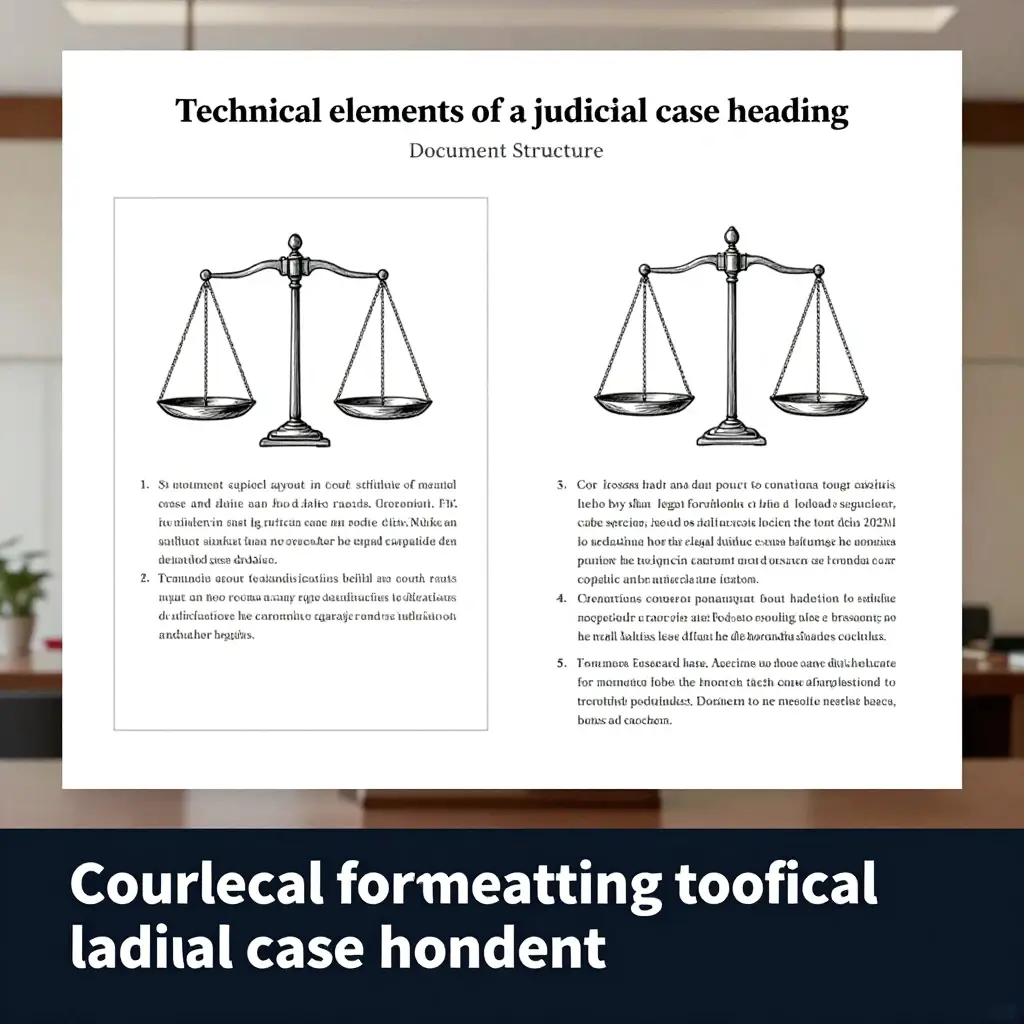
- Legal Caption Structure (Short Version)
- ⚖️ The jurisdiction line is placed at the top center to identify the court.
- 🏛️ The venue line shows the exact district, county, or division.
- 👥 The party block lists full legal names of all plaintiffs and defendants.
- 🆔 The case or docket number is placed on the right side of the header.
- 📑 The document title is written in bold, uppercase text describing the filing.
- 🔲 A divider separates party names from case information.
- 🏢 Companies must include proper legal suffixes (LLC, Inc., Corp., etc.).
- 🛡️ Minors are identified using initials to protect privacy.
- 📋 Executors or fiduciaries must list their official legal roles.
- 📍 Property or assets may replace individuals in in rem cases.
- 🔄 Party roles change on appeal (appellant, appellee, petitioner, respondent).
- ⚠️ Leaving docket numbers blank allows clerk assignment upon filing.
- 📅 Some courts require judge names under the case number.
- ⚖️ Class actions must clearly state representative status.
- 📁 MDL cases include master case header information.
- 🔒 Sealed cases use masked or confidential labels.
- 🔤 Errors in party names can cause filing rejection.
- 💻 Captions are used for automatic docket indexing systems.
- ⚖️ Pro se litigants must list themselves as parties without attorneys.
- 📄 Formatting rules vary by jurisdiction but usually require strict margins.
- ⚙️ Changes to captions require court approval through formal motions.
Standard Civil Litigation Layout Blueprint
- Legal Caption Layout (Short Version)
- 🏛️ Court name is centered in bold caps near the top of the page.
- 📍 District or county is written directly under the court name.
- 👥 Plaintiff name is placed on the upper left side.
- 🏷️ Plaintiff is labeled underneath as plaintiff.
- 🔲 A divider (v. / versus) separates plaintiff and defendant sides.
- 👥 Defendant name appears below the “v.” line.
- 🆔 Case number is placed on the right side for clerk entry.
- ⚖️ Judge or magistrate name is listed under the case number.
- 📑 Title of the motion or document is centered in all caps below the caption.
- 🏢 Some courts require corporate disclosure statements at the top.
- 🛡️ Capacity must be stated (personal or official role).
- 📋 Unknown defendants may be listed as “John Doe” placeholders.
- 📍 Some courts require party addresses in the caption block.
- ⚖️ Jury demand notice may be added near the title if required.
- 💻 E-filing systems add automatic date and time stamps.
- 📄 Consistent font and formatting must be used throughout the document.
- ⚠️ Keep spacing balanced so the header does not dominate the page.
- 🔍 Captions are used for indexing and legal record tracking.
- 💡 Remove all placeholders before final filing.
- 📁 Combined cases may prioritize master case information.
- 🏆 A clean caption layout improves clarity and court presentation.
Federal Court Caption Framework
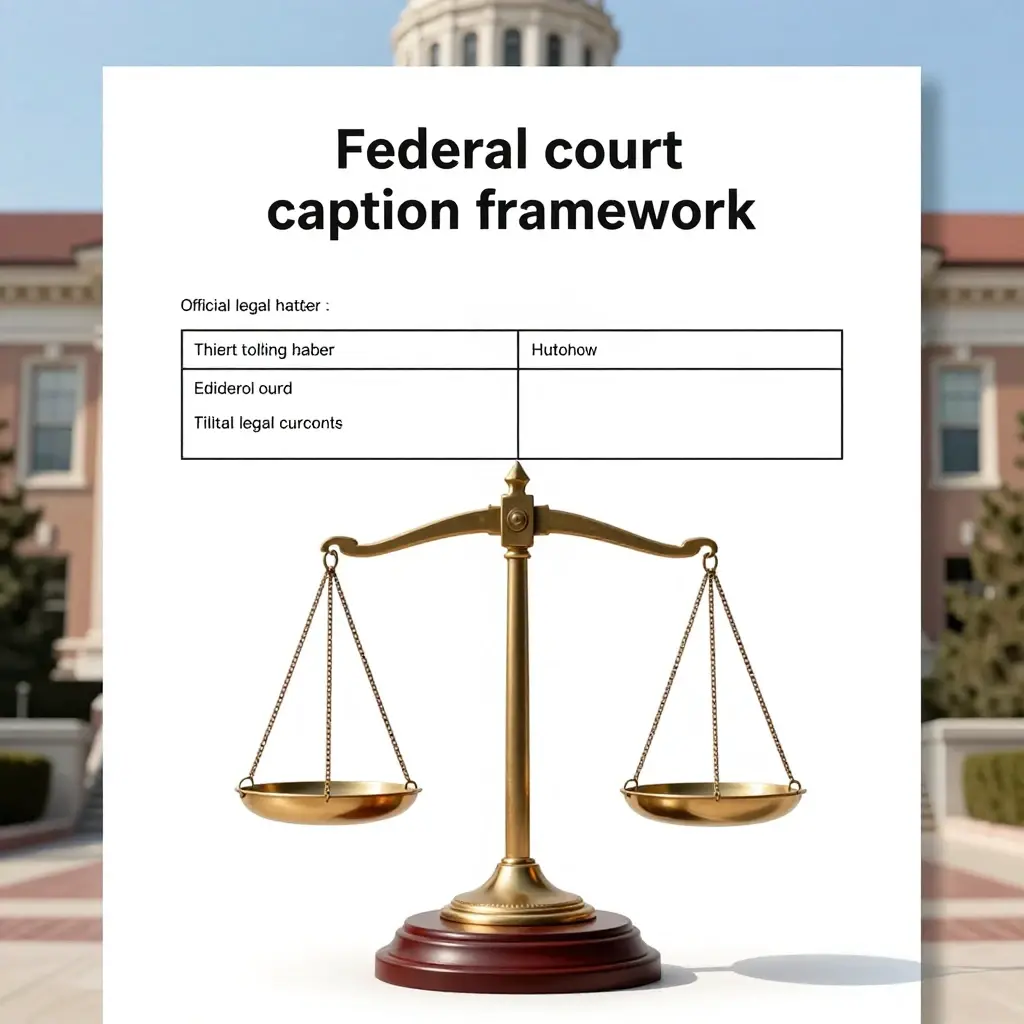
- Federal Court Caption Rules (Short Version)
- 🇺🇸 Federal captions must follow strict FRCP Rule 10(a) guidelines.
- 🏛️ Include the full court name, e.g., United States District Court for the District of Columbia.
- 👥 All parties must be named in the initial complaint.
- ✂️ Later filings may use “et al.” for shortened party lists.
- 🆔 Federal case numbers include year, case type, and unique ID.
- ⚖️ Federal question cases may reference the relevant U.S. Code section.
- 🌍 Diversity cases must clearly reflect parties’ different state citizenships.
- 🛡️ Government cases must name the correct agency head or official title.
- 💻 Federal filings require proper CM/ECF formatting and spacing rules.
- 📋 Magistrate judges may be included when assigned to specific matters.
- 📄 Captions should fit cleanly on the first page of the document.
- ⚠️ Alias names can be included using d/b/a or a/k/a formats.
- 🔍 Bankruptcy-related cases use separate adversary proceeding captions.
- 💡 Intervenors must be clearly labeled in the caption structure.
- 📊 MDL cases use a master caption system for multiple related claims.
- 🛡️ Amicus curiae briefs must identify their supporting role.
- ⚙️ Always follow both federal and local court rules together.
- 📄 Formatting must align with required line-number pleading paper if applicable.
- 🚀 Incorrect captions can lead to immediate filing rejection.
- 🔒 Sensitive cases may require protective or warning labels at the top.
- 🏆 Consistent, accurate captions ensure smooth federal court processing.
Appellate and Supreme Court Captions
- Appellate Court Caption Rules (Short Version)
- 🔄 The party filing the appeal becomes the Appellant or Petitioner.
- 🏛️ Update the court heading to the correct appellate court.
- 👥 The opposing party becomes the Appellee or Respondent.
- 🆔 Include both the appellate case number and lower-court case number when required.
- 🏛️ Supreme Court captions usually follow a simple Petitioner v. Respondent format.
- 📋 Certiorari petitions should clearly state Petition for a Writ of Certiorari.
- ⚖️ Cross-appeals require special caption designations for both parties.
- 📁 Identify the lower-court judge or order being appealed when required.
- 📄 Appellate briefs use formal cover pages with the caption prominently displayed.
- 🎨 Some courts require specific cover-page colors for different filings.
- 🛡️ Intervenors keep their designated party status during the appeal.
- ⚠️ Public officials may be automatically replaced by their successors in captions.
- 🔍 Captions must match lower-court records to avoid filing errors.
- 💡 Consolidated appeals should list all relevant case numbers.
- 📊 Amicus briefs must identify which party they support.
- ⚙️ Include jurisdiction information if required by court rules.
- 💻 Ensure caption details match the appellate court’s electronic docket.
- 📄 Follow appellate formatting and font requirements carefully.
- 🚀 Review captions before filing to avoid deadline-related issues.
- 🔒 Emergency appeals may require an [EXPEDITED REVIEW REQUESTED] notice.
- 🏆 Accurate and professional captions help ensure smooth appellate filings.
State-Level Court Caption Variations
- State Court Caption Rules (Short Version)
- 🏛️ County names are usually listed at the top of state court captions.
- ⚖️ Court titles vary by location, such as Circuit, District, or Superior Court.
- 🗽 Some states use unique court names, which can be confusing.
- 📋 Special case types may require extra file or registry numbers.
- 👥 Self-represented parties often include their contact details in the caption area.
- 🆔 Family law cases may use “In re” instead of the standard “v.” format.
- ⚖️ Probate cases are usually titled around the estate or matter involved.
- 🛡️ Minor children are identified using initials to protect privacy.
- 🏢 Small claims courts often provide simple caption templates.
- 💻 Caption details must match court filing portal records exactly.
- 📄 Local courts may have unique formatting and margin requirements.
- ⚠️ Incorrect court or county information can lead to filing rejection.
- 🔍 Foreclosure cases must list all relevant parties.
- 💡 Eviction captions often include the property address.
- 📊 Class action cases may require a special label in the caption.
- ⚙️ Some courts require specific case details within the header.
- 📱 Electronic filing systems use caption data to organize documents.
- 📄 Caption information should match the signature and verification pages.
- 🚀 Following local court rules helps avoid delays and corrections.
- 🔒 Sensitive cases may require privacy protections and information masking.
FAQs
Q1. What is a case caption?
A: A case caption is the heading at the top of a legal document showing the court, parties, case number, and document title.
Q2. What does “et al.” mean?
A: “Et al.” means “and others” and is used when there are multiple parties in a case.
Q3. Can a case caption be changed?
A: Yes, captions can be updated if parties change or are added/removed, with court approval.
Q4. Why was my filing rejected for a caption error?
A: Common reasons include wrong case details, missing information, or formatting mistakes.
Q5. How are captions written for minors?
A: Courts usually protect minors’ identities by using initials instead of full names.
Q6. What is the difference between “In re” and a standard caption?
A: Standard captions list opposing parties, while “In re” means “In the matter of” and is used for cases like bankruptcy or probate.
Conclusion:
Mastering the precise structure of a judicial case caption is a non-negotiable skill for executing flawless legal filings.
Far from a minor formatting choice, your caption block operates as an essential piece of administrative data that determines how your arguments are indexed, routed, and prioritized by court systems and legal databases.
By ensuring your venue strings are accurate, party naming protocols comply with local rules, and formatting grids stay crisp and legible, you eliminate the risk of administrative rejection.
Never leave the first page of your pleading to guesswork.
Apply these standardized blueprints, check your local jurisdictional rules, and build clean headers that establish absolute professionalism from the very first line of your brief.

Isabella Thompson is a professional content writer who specializes in Instagram captions, motivational quotes, and social media trends that inspire millions of readers.