
A caption in a book is a short explanatory text placed near an image, illustration, diagram, table, graph, or figure to describe what the reader is seeing.
It helps connect visual elements with written content so that information becomes easier to understand.
Instead of leaving images unexplained, captions provide clarity, context, and meaning in just a few words.
In 2026 publishing standards, captions are considered essential in textbooks, research papers, educational materials, and digital books because they improve comprehension and learning speed.
A well-written caption makes complex visuals simple and helps readers quickly interpret data without reading long paragraphs.
If it is a science diagram, historical photo, or statistical chart, captions play a powerful role in communication within books.
Meaning of Caption in a Book
- 📖 A short descriptive line inside a book
- 🖼️ Usually placed below images or figures
- 🧠 Explains what the visual represents
- 📊 Used in charts, graphs, and tables
- 🎯 Gives a quick understanding to readers
- ✏️ Written in simple language
- 📚 Common in textbooks and research books
- 🔍 Helps interpret visual information
- 💡 Acts like a label for images
- 🧩 Connects text with visuals
- 🌍 Used in all types of publishing
- 📸 Found in illustrated content
- 🧠 Improves comprehension speed
- 📖 Makes reading easier
- 🎓 Important in academic learning
- 📈 Used in scientific reports
- 🖍️ Very short and precise
- 📍 Always placed near visuals
- ✨ Enhances learning experience
- 📘 Supports educational content
- ❤️ Improves reader engagement
Purpose of Captions in Books
- 📖 Explain images clearly to readers
- 🧠 Improve understanding of visuals
- 🎯 Support written content in books
- 📊 Simplify complex data
- 📚 Enhance learning experience
- 🔍 Provide quick reference
- 🖼️ Describe illustrations effectively
- 💡 Add meaning to visuals
- 📈 Increase educational value
- 🧩 Connect ideas visually
- ✏️ Save reading time
- 🌍 Used globally in education
- 🎓 Help students learn faster
- 📍 Clarify book content instantly
- 📖 Improve comprehension level
- 💬 Support storytelling in books
- 🧠 Reduce confusion in learning
- 📸 Give context to images
- 📘 Make books interactive
- ❤️ Improve reader experience
- ✨ Strengthen understanding
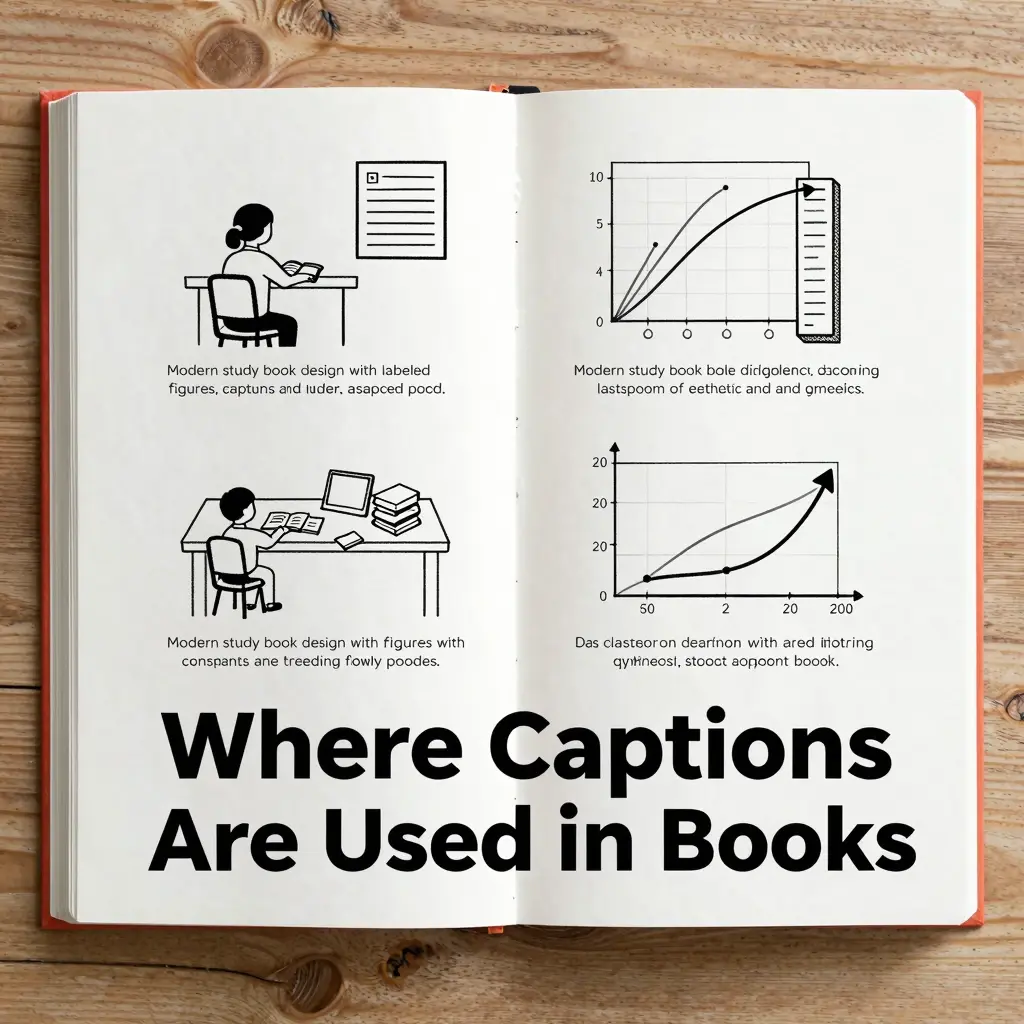
Where Captions Are Used in Books
- 📖 Under photographs and images
- 📊 Below statistical charts
- 🧠 Near scientific diagrams
- 📚 In school textbooks
- 📘 In academic research papers
- 🖼️ In illustrated storybooks
- 🎓 In educational guides
- 📈 In business reports
- 🔬 In science manuals
- 🧩 In technical books
- 📍 In maps and geography books
- ✏️ In design and art books
- 📸 In historical books
- 🌍 In travel books
- 🧠 In psychology books
- 📖 In reference encyclopedias
- 📊 In data analysis books
- 📚 In training manuals
- 📘 In eBooks and digital PDFs
- ❤️ In children’s books
- ✨ In modern online learning books
Types of Captions in Books
- 🖼️ Image captions for photos
- 📊 Figure captions for diagrams
- 📈 Graph captions for charts
- 🧠 Table captions for data tables
- 📍 Map captions for geography visuals
- 🔬 Scientific captions for experiments
- 🎓 Educational captions for learning
- 📖 Descriptive captions for explanation
- ✏️ Explanatory captions for clarity
- 📸 Historical captions for old images
- 🧩 Technical captions for engineering
- 📘 Concept captions for ideas
- 🌍 Cultural captions for traditions
- 📊 Statistical captions for data
- 🧠 Analytical captions for research
- 📖 Instructional captions for steps
- 📍 Location captions for maps
- ✨ Creative captions for storytelling
- ❤️ Narrative captions for books
- 📈 Performance captions for results
- 🔍 Reference captions for study
Importance of Captions in Books
- 📖 Improve reader understanding instantly
- 🧠 Help explain complex visuals
- 🎯 Increase learning efficiency
- 📊 Support interpretation of data
- 📚 Make content easier to read
- 🔍 Reduce confusion in visuals
- 🖼️ Add clarity to images
- 💡 Enhance communication in books
- 📈 Improve academic performance
- 🧩 Connect written and visual content
- ✏️ Strengthen study material quality
- 🌍 Used across all educational systems
- 🎓 Help students learn faster
- 📍 Provide quick explanations
- 📖 Improve the readability of books
- 💬 Support teaching materials
- 🧠 Aid memory retention
- 📸 Make visuals meaningful
- 📘 Increase textbook value
- ❤️ Enhance learning experience
- ✨ Improve content professionalism
Examples of Captions in Books
- 📖 “Figure 1: Structure of human heart”
- 📊 “Table 2: Population growth statistics”
- 🧠 “Diagram showing cell division process”
- 📍 “Map of ancient trade routes”
- 📈 “Graph of yearly sales increase”
- 🖼️ “Photograph of historical monument”
- 📚 “Illustration of food chain ecosystem”
- 🔬 “Microscopic view of bacteria cells”
- 📘 “Flowchart of decision-making process”
- 🎓 “Timeline of world history events”
- 📖 “Sketch of architectural building design”
- 🌍 “World climate zones map”
- 🧠 “Neural network diagram”
- 📊 “Bar chart comparing performance”
- ✏️ “Hand-drawn scientific illustration”
- 📸 “Field research photograph”
- 📈 “Statistical trend analysis graph”
- 🧩 “Concept map of ideas”
- 📍 “Elevation map of region”
- 📚 “Illustrated story scene from book”
- ❤️ “Annotated educational image”
How Captions Help Students
- 📖 Make learning easier and faster
- 🧠 Improve concept clarity
- 🎯 Support visual memory learning
- 📊 Help understand data quickly
- 📚 Improve study efficiency
- 🔍 Reduce confusion in textbooks
- 🖼️ Explain diagrams clearly
- 💡 Simplify difficult topics
- 📈 Improve academic results
- 🧩 Connect ideas visually
- ✏️ Help revision process
- 🌍 Useful in all subjects
- 🎓 Support exam preparation
- 📍 Provide quick reference points
- 📖 Make reading interactive
- 💬 Improve comprehension skills
- 🧠 Strengthen understanding
- 📸 Add visual context
- 📘 Improve textbook usability
- ❤️ Increase interest in learning
- ✨ Make education engaging
Difference Between Caption and Title
- 📖 Caption explains an image
- 🧠 Title introduces a section or chapter
- 🖼️ Caption is image-based
- 📚 Title is content-based
- 🎯 Caption is short and descriptive
- 📊 Title is broader and more general
- ✏️ Caption is placed near visuals
- 📍 Title is placed at top
- 💡 Caption gives context
- 📘 Title gives topic overview
- 🧩 Caption is specific
- 🌍 Title is universal
- 📸 Caption supports visuals
- 📖 Title leads content
- 🧠 Caption is explanatory
- 🎓 Title is structural
- 💬 Caption is descriptive text
- 📈 Title is organizational
- ✨ Caption enhances clarity
- ❤️ Title defines section
- 🚀 Both work together in books
FAQs
Q1. What is a caption in a book?
A: A caption is a short text that explains images, figures, or diagrams inside a book.
Q2. Where are captions used?
A: They are used with images, charts, tables, and diagrams in books.
Q3. Why are captions important?
A: They help readers understand visual content quickly and clearly.
Q4. Are captions long or short?
A: Captions are usually short, simple, and precise.
Q5. What books use captions?
A: Textbooks, research books, storybooks, and educational materials.
Q6. What is the difference between a caption and a title?
A: A caption explains visuals, while a title introduces a section or chapter.
Conclusion:
A caption in a book is a small but powerful element that adds meaning to visuals and improves understanding.
It helps readers connect images with written content, making learning easier and more effective.
In 2026 publishing, captions remain essential in education, research, and storytelling because they enhance clarity, engagement, and knowledge retention.
Without captions, visuals lose meaning, but with them, books become more interactive and informative.

Emma Richardson is a passionate and creative content writer who specializes in crafting engaging captions, social media content, and lifestyle-inspired writing. With a deep understanding of modern digital trends, she helps readers express emotions, moments, and stories through perfectly written captions that connect and inspire.